2026-05-22
About Seiko Chronograph movement holders
There seems to be an infinite number of vintage Seiko tools for many different applications and many different movements. One type of the tool that is still very handy to have today when working on vintage Seiko watches is the movement holder. They are especially useful for the chronographs and I would quite often see them used for the caliber 6139. And for one, because of the popularity of the 6139 movement, the blue S-501 holder is also something that one would come across online sooner than later, when seeing other fellow watch tinkerers working on these awesome machines.
Why would I need a special holder anyways?
The movement holders for the chronographs are important not for their convenience and perfect fit, but rather as a proper way of pressing on the seconds hands and subregister hands. Chronograph hands require quite some force to be able to put them on. Because the mechanical chronograph reset is quite violent, and the recording hands need to fly back to the "0" position in the blink of an eye, the axle of the chronograph wheel that holds the hand has a D-shaped profile. Then when the round hand tube is pressed onto the axle, the tube takes the shape of the axle and is fitted firmly with friction and will not slip on the axle from the inertia as the hand flies back to "0". So in a way each chronograph hand is paired with the chronograph wheel, because the orientation of the "D" profile can be different between different watches.
And because pressing on the hand to mould the tube onto the axle takes quite some pressure to be applied, there is risk of damaging the center chronograph wheel or pushing out the jewel in the chronograph bridge while doing so if the chronograph wheel axle or the jewel are not supported from below. Well, that's my understanding of it at least.
Let's take a look at the chronograph wheel diagram from the 6139A movement as shown in the image below.
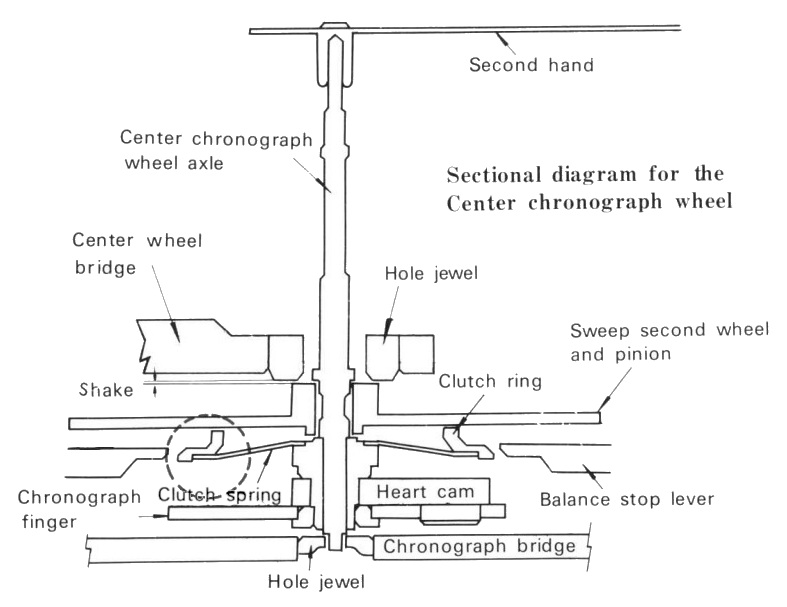
So, we can now imagine that pressing hard on the second hand from the top could put pressure on the hole jewel in the chronograph bridge at the bottom of the diagram. The movement holders have a dowel in the middle that support either the jewel or the chronograph wheel axle.
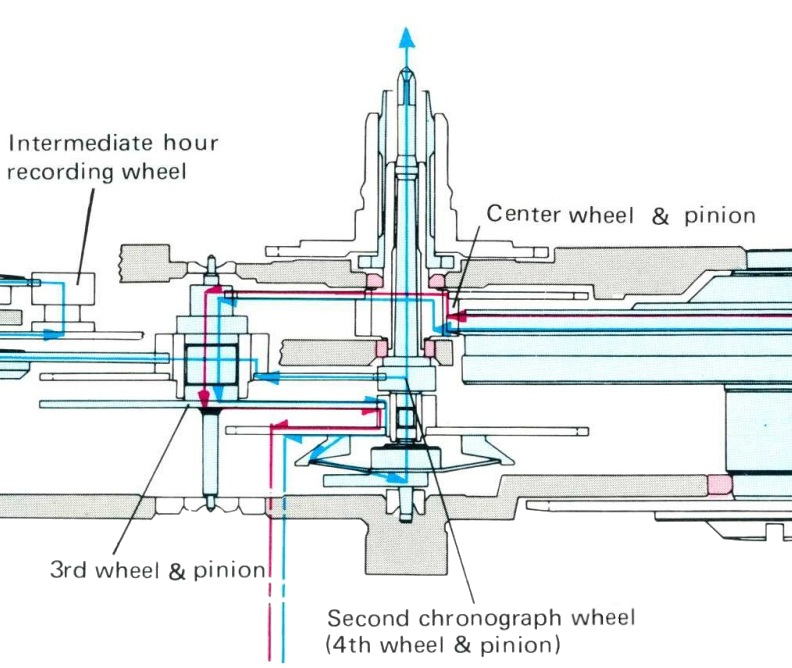
And below is the chorongraph wheel as shown in the 7016A service guide. One thing that stands out from the cross-section at least is that the hole jewel in the barrel and train wheel bridge seems to be supported by the bridge itself and would not be at risk of being pushed out? I am not sure about that. Perhaps the 70xx series chronographs could be less prone to the issue of dislocated jewels while pressing the seconds hand, but I don't want to test that myself.
Lost in the numbers
It was not until I got to work on my first chronograph movement - 7015A - that I needed to look into these Seiko movement holders in more detail. As usual, there is a plethora of different Seiko chronograph movements and their variants. From the 61xx and 70xx automatic chronographs we have:
- 6138A
- 6138B
- 6139A
- 6139B
- 7015A
- 7016A
- 7017A
- 7018A
Now if you go an have a search for the movement holders, the sources would usually just mention that the S-500, S-501 are for the 61 series, and the S-510, S-511 is for the 70 series.
As usual with anything watch related, the devil is in the details. And so when I finally got my hands on the S-510 movement and put my 7015A in it, the hammer to reset the chronograph could not be pressed in! I was very much disappointed in that.
As you can see the fit is pretty much perfect, apart from that little detail it seems.
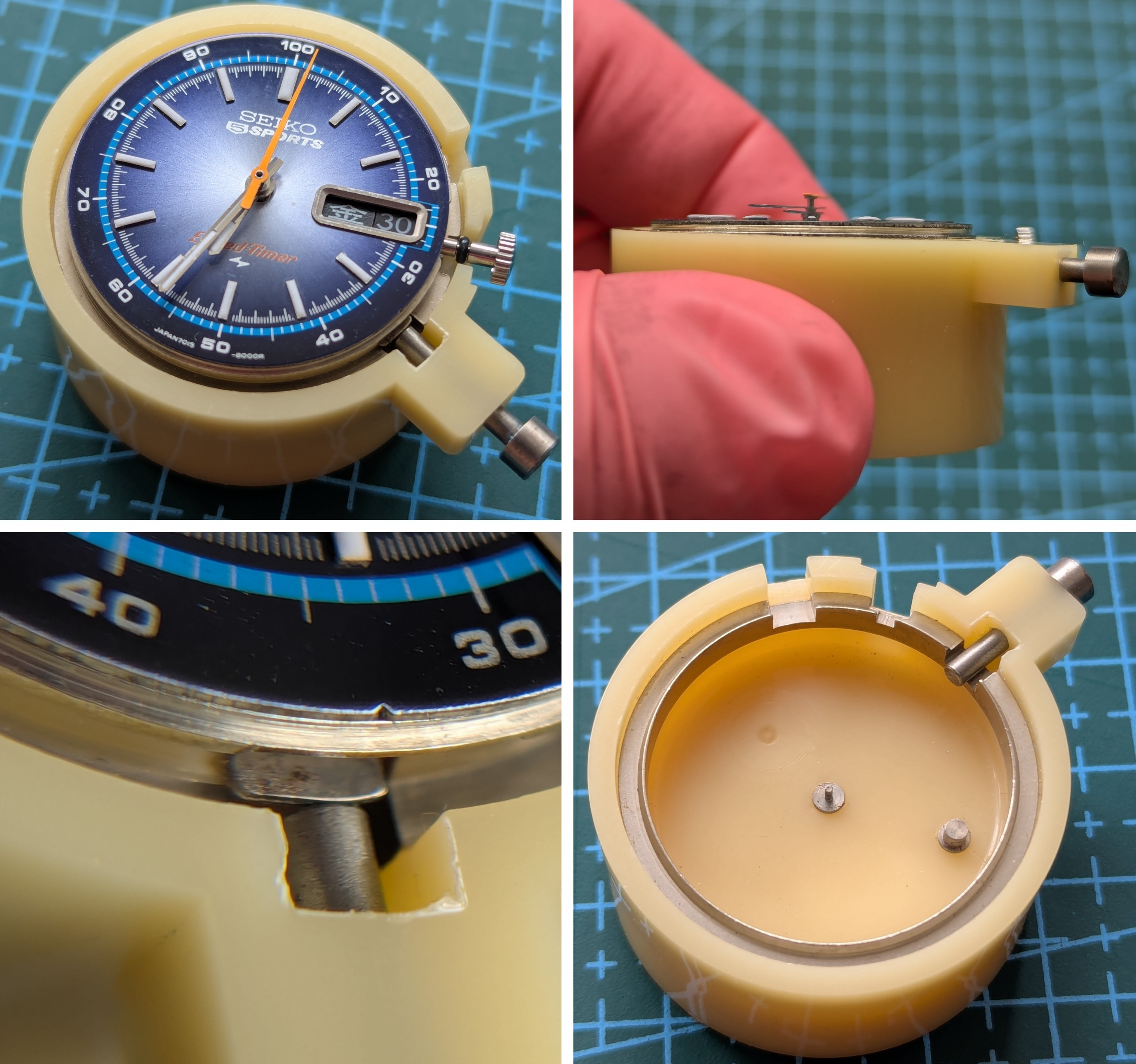
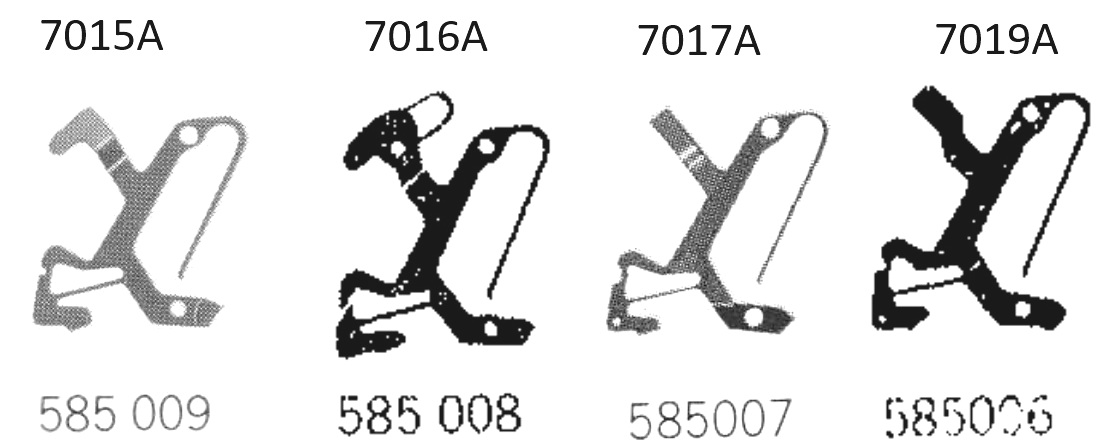
Well, in this case each of the 70 series movements uses a different hammer. And in case of the 7015A/7016A the part of the hammer that interacts with the pusher is elongated and L-shaped. Hence it requires a larger cutout in the holder ring than in case of the 7017A or 7018A hammer.
And in fact there is yet another movement holder specifically for the 7016A, with a larger cutout, and it is the S-512 holder. Image of the S-512 borrowed from vintagewatchparts.net.
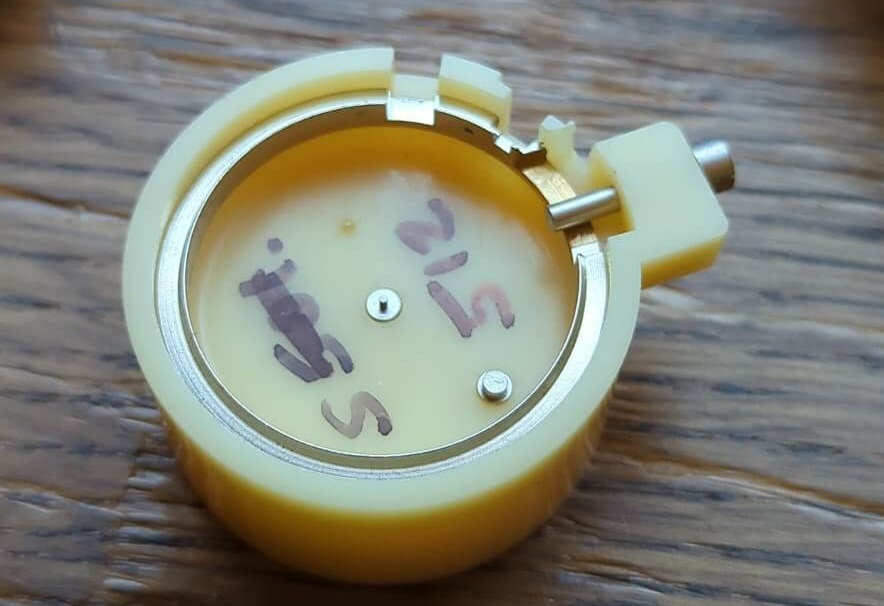
Now the question is, are other dimensions between the S-510 and S-512 the same? And could one simply file down the metal ring around the reset pusher to fit in the 7015A and 7016A hammer and use it instead of the S-512 which seems to be especially rare?
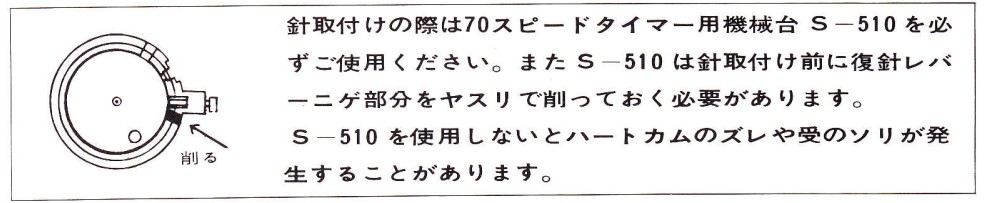
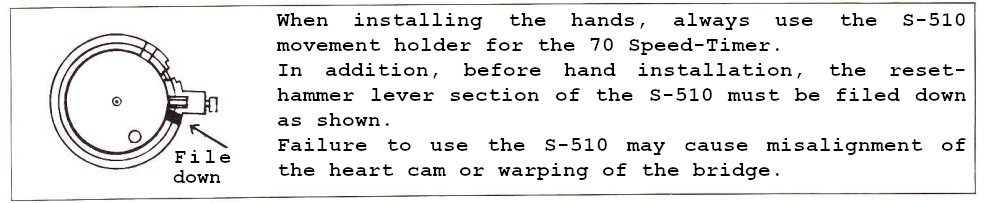
The answer is, yes. And this is confirmed by the Seiko 7015A service guide, which specifically mentions the need of filing the S-510 movement holder near the chronograph reset lever to make the 7015A fit.
And here is the English translation of the above:
I got the plastic part of the movement masked with tape and proceeded with filing down the marked section. I admit it's not the prettiest job, but it worked and now my S-510 works with 7015A movement!
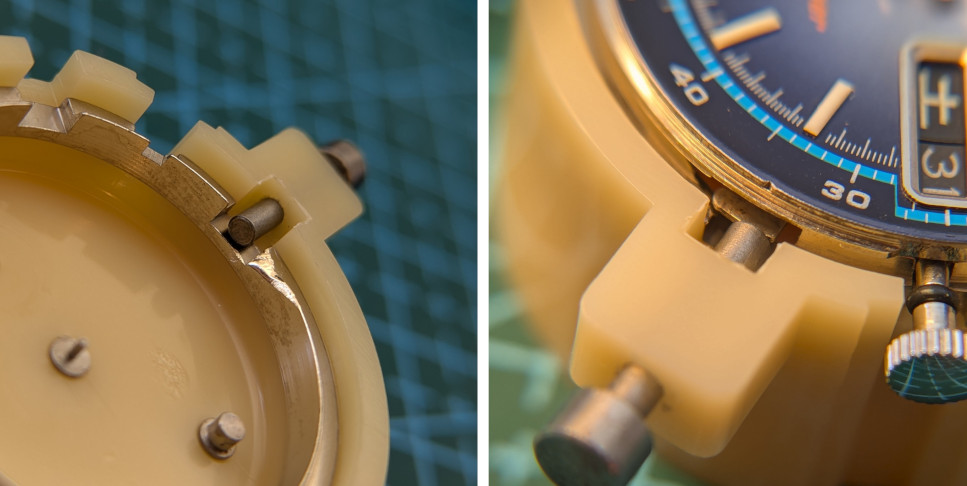
Part of me would love to keep the movement in its original form, but I also want to use the tools, as that's their purpose. Considering that the S-512 holder is basically unobtainium, I'm alright with the modification. Especially that Seiko themselves advised to do that, so I feel forgiven.
So which holder for what movement?
Here is the mapping between holders and the different movements as I understand it today:
- S-500: 6139A
- S-501: 6138A, 6138B, 6139B
- S-510: 7017A (and 7015A after modification)
- S-511: 7017A, 7018A
- S-512: 7015A, 7016A
There is one caveat with the S-510 and S-511 movement. They were both made as complete tools, but also it looks like Seiko at some point distributed the central dowels/pins for the S-510 movement to be able to effectively convert it into S-511.
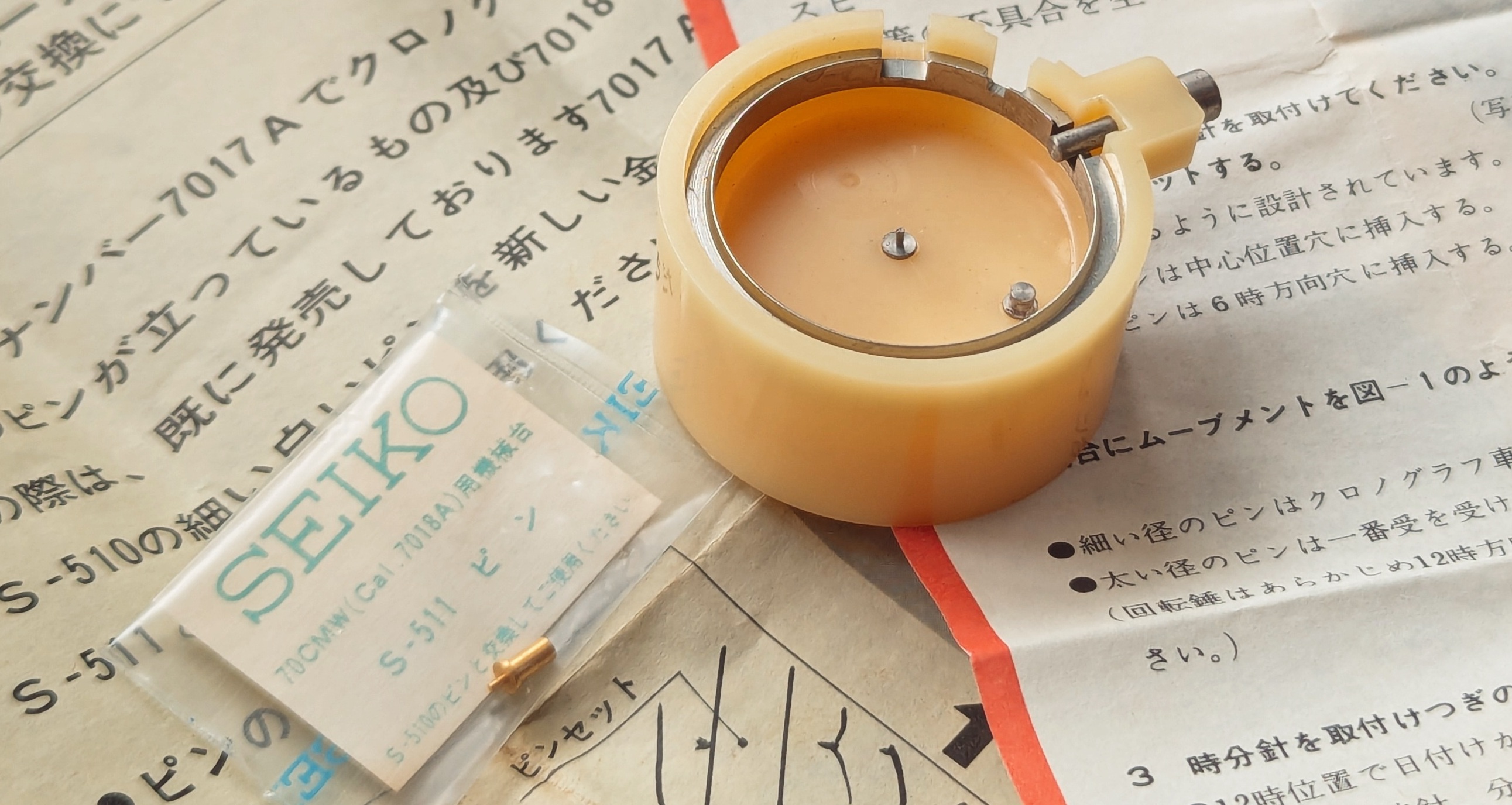
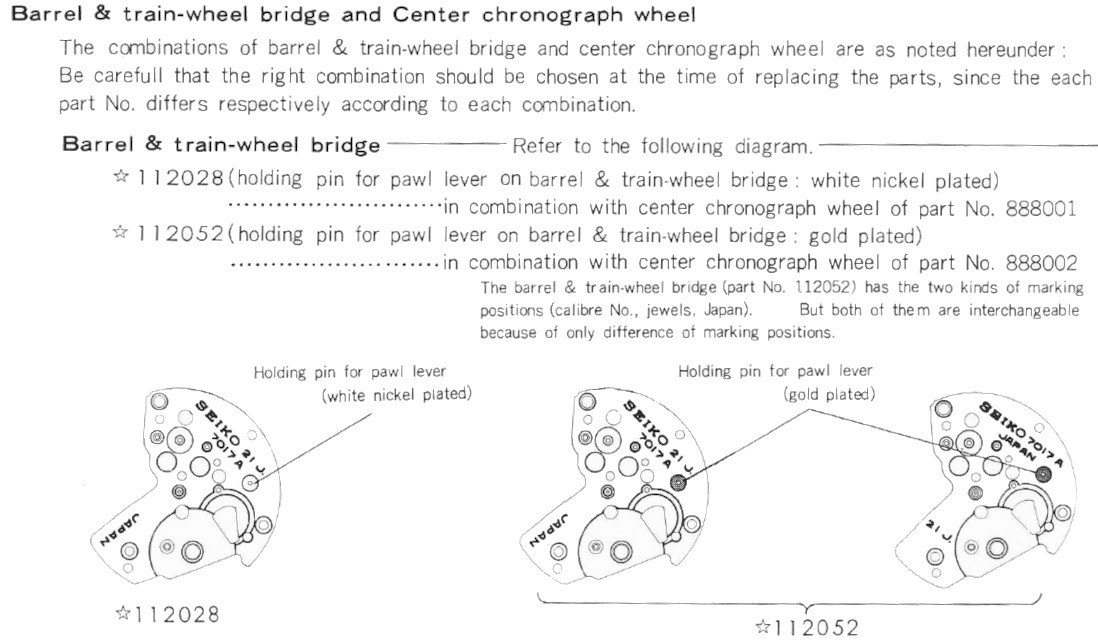
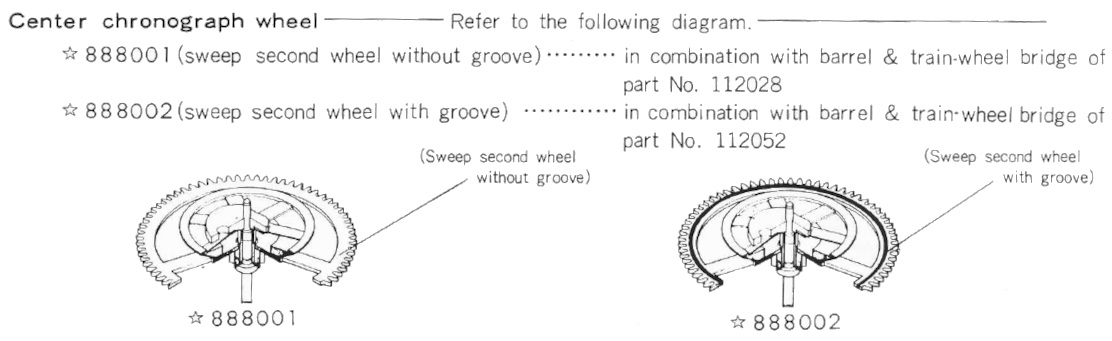
The piece of instructions attached to that conversion kit mentions that the silver coloured pin should be used for the movements with the silver pin in the barrel and train bridge and the gold coloured dowel/pin should be used if the pin on the bridge is gold coloured. Just if it was not confusing enough.
So here is a fragment from the 7017A Parts List which mentiones the different movement variants. They use a different central chronograph wheel and different barrel and train bridges.
Well, I hope this helps to untangle the Seiko 61 and 70 Chronograph movement holders at least in some way.